Learn the rhythm,
or teach the room.

EKGLabhas you covered, beat for beat.

Real patient recordings, for both sides of the classroom. Measure a beat, quiz yourself lead by lead, or put the trace on the projector and ask the class what they see.

ekglab.com/player?record=223
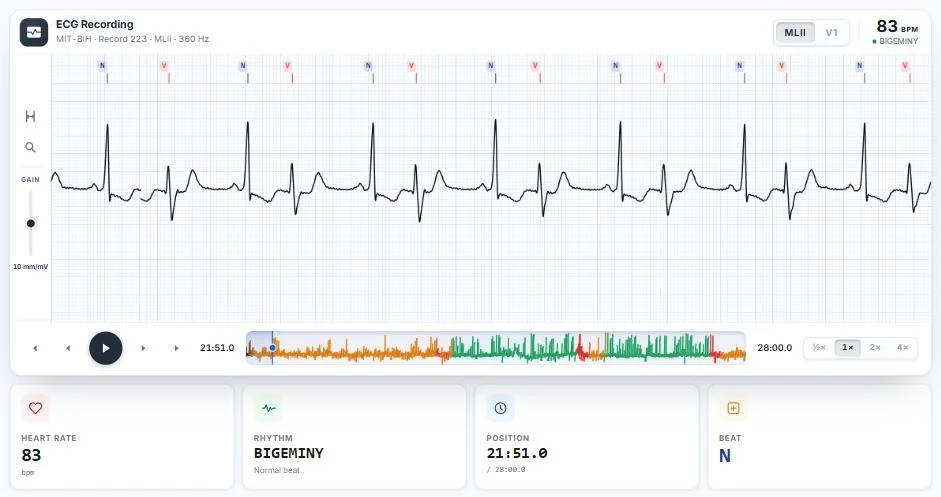
The ECG Player on MIT-BIH record 223, lead MLII: ventricular bigeminy at 83 bpm, with every beat labelled N or V.
MIT-BIH 223 · lead MLII · every beat labelledLive: press play, switch leads, measure with calipers

The best of the lab.

Every picture here is the real screen. The tag on each tool is the plan that includes it.

Choose Your Path
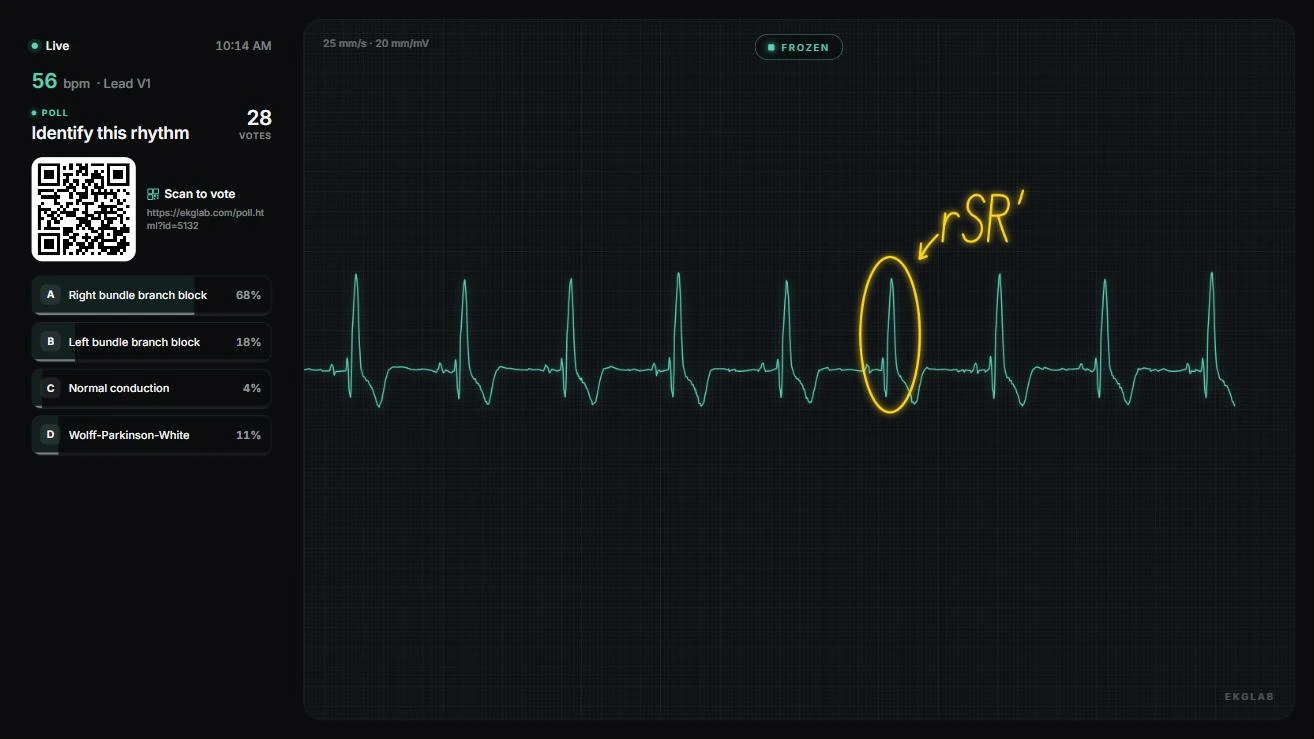
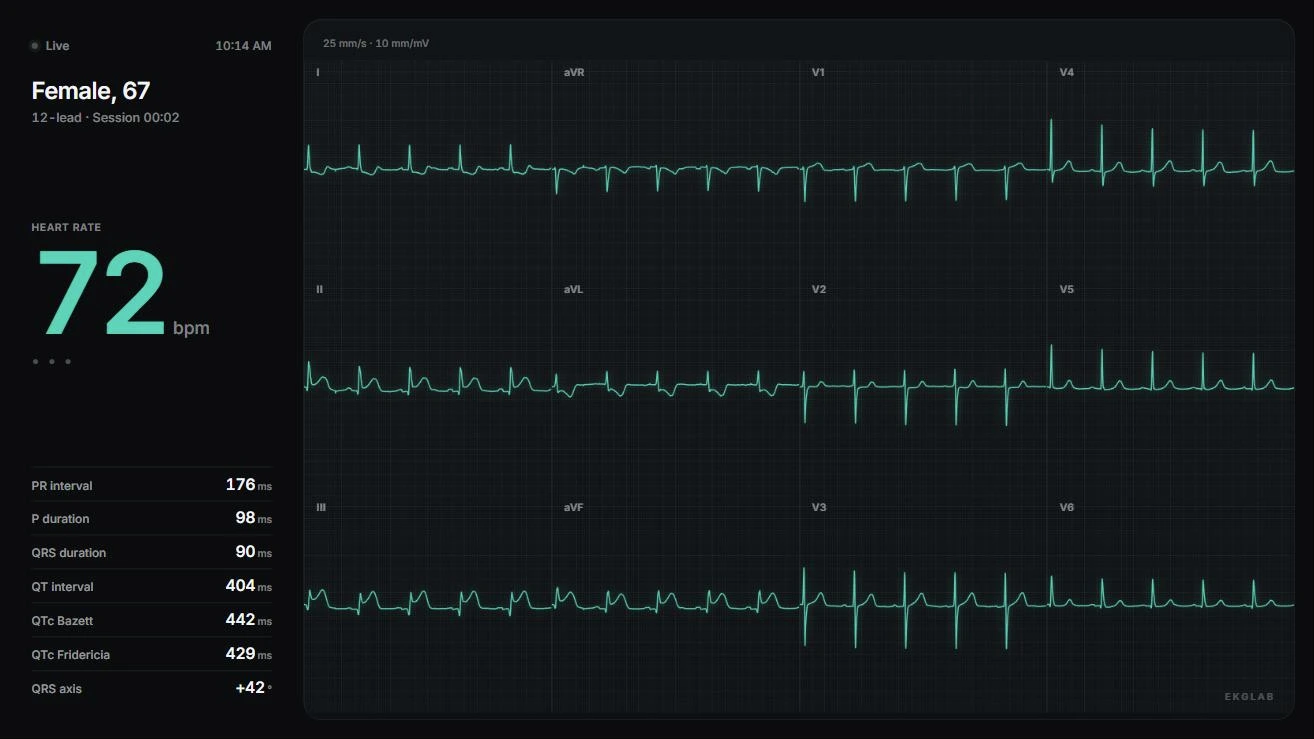
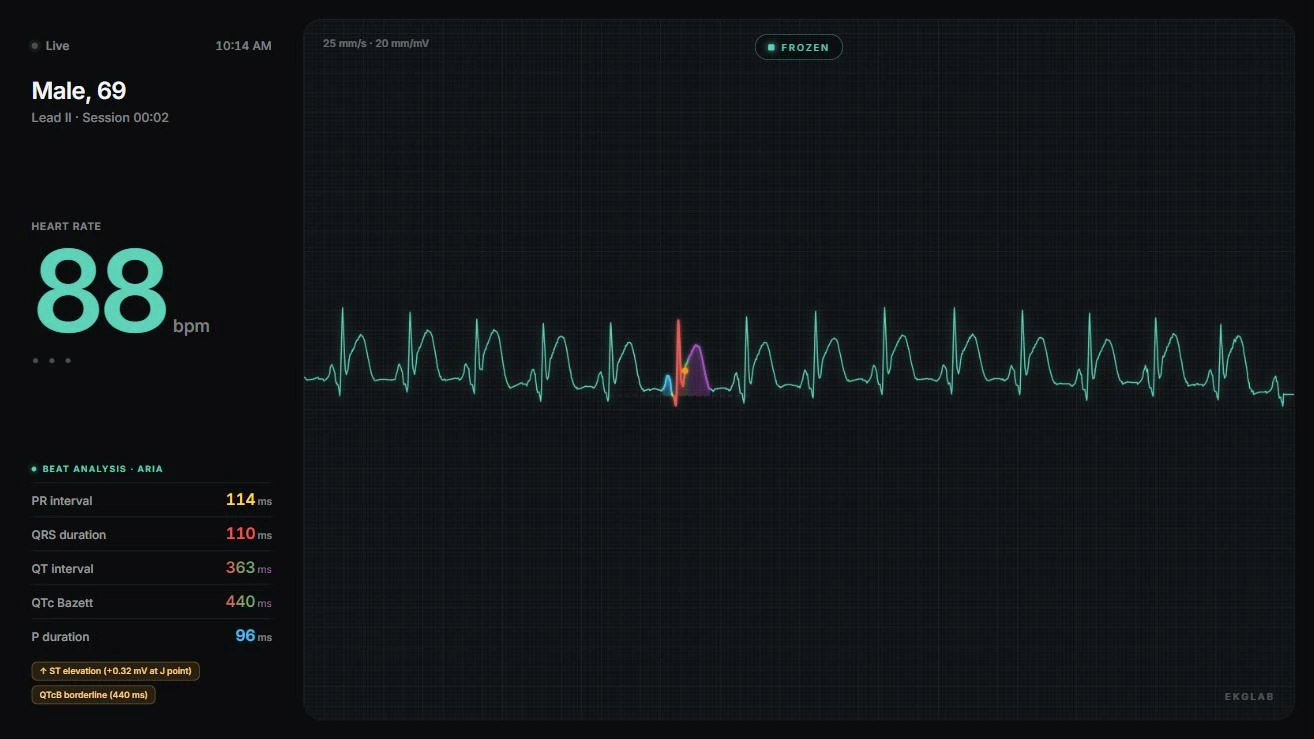
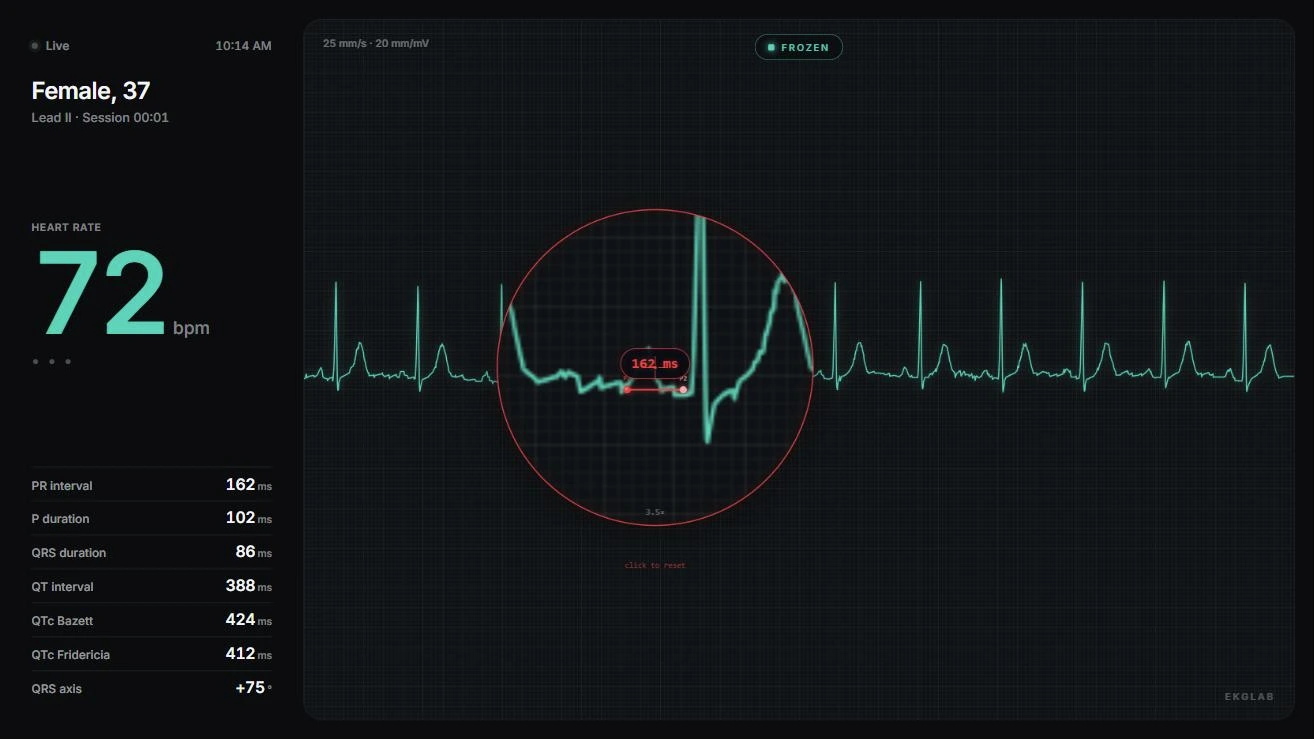
The student display on a classroom TV: PTB-XL record 00788, lead V1, frozen at 56 bpm, showing the rSR' pattern of right bundle branch block: the instructor has circled one complex and handwritten rSR' beside it with an arrow, beside a live poll with a QR code and 28 votes, Right bundle branch block leading at 68 percent.The student display showing a full 12-lead broadcast of PTB-XL record 12899, a woman aged 67 with an acute inferior STEMI at 72 bpm: ST elevation in II, III and aVF with reciprocal depression in I and aVL, beside the record's measured intervals.The student display showing an ARIA beat analysis broadcast on PTB-XL record 01063, lead II, a man aged 69 with an acute anterior STEMI at 88 bpm: one beat coloured by segment, PR 114 ms, QRS 110 ms, QT 363 ms and QTcB 440 ms, flagged for ST elevation of 0.32 mV at the J point.The student display with the magnifier broadcast on PTB-XL record 00174, lead II, a woman aged 37 in normal sinus rhythm at 72 bpm: the lens enlarges one beat 3.5 times, with calipers inside it measuring the PR interval from P-wave onset to QRS onset at 162 ms.
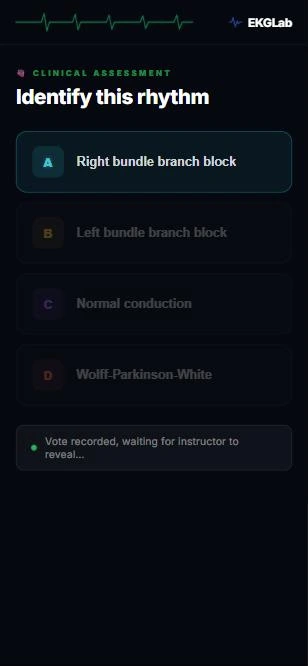
A student's phone on the EKGLab poll page after scanning the QR code: Identify this rhythm, with Right bundle branch block tapped and the note Vote recorded, waiting for instructor to reveal.

Broadcast to the room

Instructor

One click puts your screen on the room’s display. Broadcast any of the 21,799 real 12-leads, hours of arrhythmia recordings, or a trace you built in Waveform Studio. The rhythm name stays hidden until you reveal it, so the class commits to a read first. Draw on the live trace, magnify a beat and measure it, put up an ARIA analysis, or run a poll the class answers by phone.

See broadcast
35+

Hours of arrhythmia recordings

Free

A 10-second strip shows one rhythm. These run for half an hour, the way a monitor sees a patient: rhythms start, stop and change mid-strip. They are the reference recordings arrhythmia detectors are tested against.

Every beat labelled
Normal, PVC, paced and more on every MIT-BIH beat, annotated independently by two or more cardiologists.
Catch the moment it changes
A timeline of the whole recording takes you straight to the run of VT or the burst of atrial fibrillation.
From
MIT-BIH Arrhythmia Database
24 hours
MIT-BIH Malignant Ventricular Ectopy Database
11 hours
See the library
21,799

Real 12‑lead ECGs

Free

Not textbook drawings: real patients, from STEMIs and bundle branch blocks to hypertrophy and the normals you compare them with. The whole PTB-XL library, and every record opens free.

Measured on every record
Heart rate, PR, QRS, QT, QTc and axis are already there, with ST deviation flagged lead by lead.
The expert read
The original clinical report and a cardiologist-validated diagnosis, so you can check your read against theirs.
Hands on the trace
Calipers, a magnifier, lead switching, a full-screen 12-lead sheet and a discussion under every record.

On Pro, search it in plain English:
“inferior STEMI in a woman over 70”

See the library
Limitless
Possibilities

Waveform Studio

Free

Real recordings show what happened. The Studio shows what could: build any 12-lead you can imagine, one slider at a time.

Shape every wave
P, PR, QRS, ST and T on sliders and the axis on a compass, with all twelve leads redrawn as you drag.
Patterns on demand
Infarct territories, conduction blocks, paced rhythms and electrolyte changes, every lead responding the way it should.
Never mistaken for real
Everything the Studio draws is teal, so a synthetic trace never passes for a patient’s.
See Waveform Studio
ekglab.com/player?record=10998

One 12‑lead, every way to read it

Free

Every view is one button on the panel, so the same tracing can be rearranged, turned over and printed in a click. Shown here on PTB-XL 10998, an inferolateral infarct.

Arrange the leads

Standard

The classic printout: twelve leads that read as one continuous 10 seconds.

Simultaneous

Every lead at the same moment, scrubbed through the recording.

Cabrera

The limb leads in anatomical order around the frontal plane.

See the injury

ST Map

Shades every lead that meets AHA criteria for ST elevation or depression, so the territory and its reciprocal leads stand out.

Flip

Turns the tracing upside down, so ST depression reads as the elevation it mirrors.

Vector loopPro

The heart’s electrical path drawn in space, with the frontal, horizontal and sagittal planes a click away.

Take it to class

Full screen

One calibrated sheet of ECG paper, with the lead II rhythm strip underneath.

Export PDFPro

A high-resolution 12-lead for print or a slide. Switch off anything the handout should not show.

  • Demographics (off)
  • Record ID (off)
  • Measurements (on)
  • ST measurements (on)
  • Diagnosis (on)
  • Calibration (on)

The traces and the source credit always print.

Autonomous Rhythm and Interval Analyzer

Pro

Click any beat and ARIA takes it apart in under 5 ms. It outlines the P wave, QRS, ST segment and T wave, measures PR, QRS, QT and QTc across all twelve leads, and flags anything outside AHA limits.

Disagree with a boundary? Drag it, and every interval and flag recomputes on the spot. ARIA is deterministic signal processing, so the same beat always gets the same answer. Every segment keeps the same color on every beat (P, PR, QRS, ST and T), so students learn to pick out each wave at a glance and start to see patterns across beats and leads.

Shown here on PTB-XL 01484: ARIA flags a first-degree AV block with a PR of 218 ms, then the J point is moved by hand and every value follows.

ekglab.com/simulator
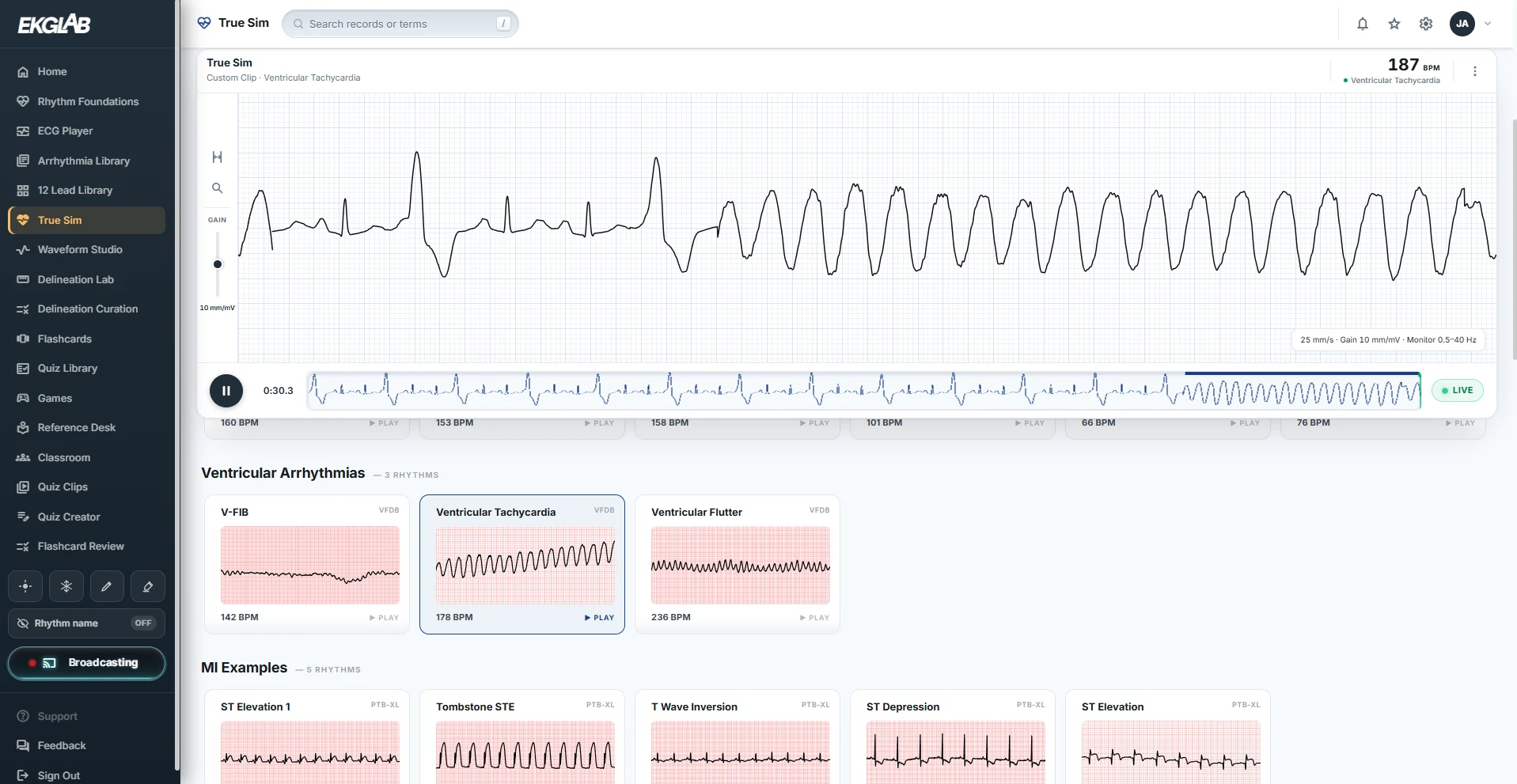
True Sim on an instructor's laptop while broadcasting: a real recording of ventricular tachycardia playing on the live sweep at 187 bpm, the clip tape below it, and the clip library of real rhythms grouped into ventricular arrhythmias and MI examples, each tagged with its source database.

True Sim

Pro

The first rhythm simulator built only from real patient recordings. Every clip is cut from an actual patient’s ECG, never a synthetic variant, so the class learns on the noise, artifact and beat-to-beat variation of the real thing.

Instructors can build their own library of clips. Pick any of thousands of recordings, mark the stretch you want, and it runs on the live monitor or goes straight to the room’s display.

InstructorClip creator

Waveform Studio

Free

Build a 12-lead from scratch. Drag sliders to shape the P wave, PR, QRS, ST segment and T wave, turn the QRS axis on a compass, and watch all twelve leads redraw as you go, with the rate, intervals and axis recalculated live.

Pick a pattern and every lead responds the way it should. Choose the anterior territory and ST rises in V3 and V4, with a note on why. The sets cover infarct territories, conduction blocks, atrial, escape and ventricular rhythms, paced rhythms and electrolyte changes.

Everything the Studio draws is teal, so a synthetic ECG is never mistaken for a patient’s. Save a build as a preset, export it as a 12-lead PDF on Pro, or broadcast it to the room on the Instructor plan.

ekglab.com/games

Games with Joules

Free

Three arcade games where the way forward is reading an ECG. In Conduction Quest, Joules crosses six worlds of a medical city, and the rhythm radar along the bottom plays a live strip you have to read to open each rhythm gate.

Rhythm Runner has you name each rhythm before its points drain away, and Node Runner walks Joules through the conduction system one station and one question at a time. Both post your best run to a leaderboard.

Free on every plan, right in the browser.

Classroom Monitor

Instructor

Watch your whole class in one place. Mastery by topic, the class average, and a roster that puts the students who need attention first, flagged for review before the exam, not after it.

Open any student to review every test they took across the class, question by question, with the exact strip or 12-lead they saw, what they answered and the correct answer. Print it or save it as a PDF for a one-to-one.

Assign quiz sets to a whole cohort in one click, see who has not started, and export grades at the end of the term.

See instructor plans
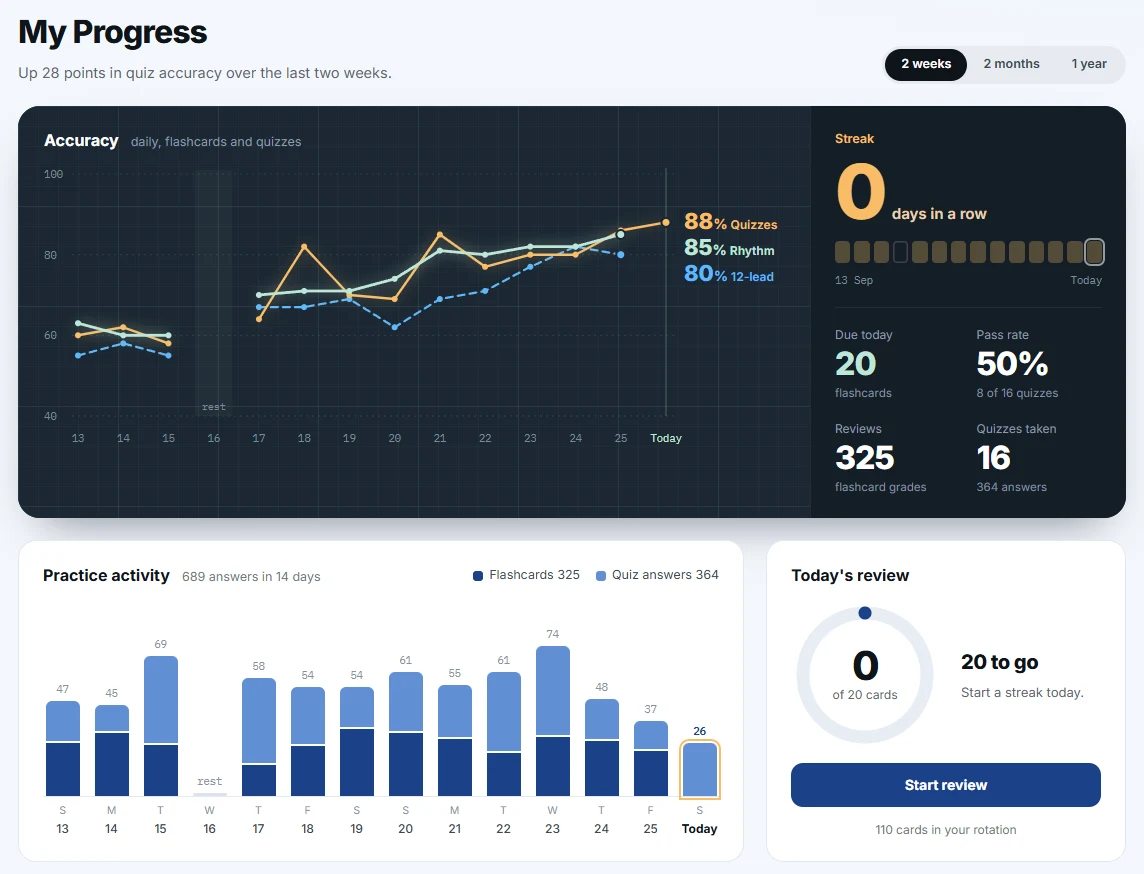
The My Progress dashboard on a tablet: accuracy over two weeks drawn as lines for quizzes at 88 percent, rhythm at 85 and 12-lead at 80, a panel with the streak, cards due today, a 50 percent pass rate over 16 quizzes and 325 flashcard reviews, daily practice bars split into flashcards and quiz answers, and today's review ring.

Track your progress

Pro

Every flashcard you grade and every quiz you take lands on one dashboard. Accuracy for rhythm, 12-lead and quizzes is drawn day by day, so you can see where you are improving and where you are not yet.

Your streak, the cards due today and every quiz score sit beside it. Each score shows its pass mark, so a near miss is easy to spot and easy to retake, and mastery by topic points to what needs work next.

Switch between two weeks, two months and a year for the long view.

Compare plans

Also in the lab: the Delineation Lab, spaced-repetition flashcards, My Progress, Rhythm Foundations, a 158-term EKG Dictionary, and a discussion under every record.

The whole room reads the same beat.

One click mirrors your monitor to the projector. From there you teach on the live trace itself, and everything you point to, draw or freeze lands on the class's screen in real time.

01 Laser pointerYour cursor becomes a glowing dot on every screen in the room.
02 Draw on the traceCircle the ST segment or sketch the axis, freehand, live.
03 Highlight the signalPaint a run of beats to pull one pattern out of the rest.
04 Freeze both screensHold the class on a single complex while you talk it through.
05 Reveal the rhythmKeep the name hidden so they call it first, then reveal.
06 Live pollsThe room answers on their phones, tallied on screen instantly.

Real patients. Expert reads.

Every recording comes from a published research database. Every 12-lead carries a cardiologist’s interpretation, and every MIT-BIH beat was labelled by two or more cardiologists, so you can check your read against theirs.

11hrs
Malignant ventricular ectopy
11 hours of arrhythmia recordings with ventricular ectopy, including sustained VT, flutter and fibrillation.
24hrs
MIT-BIH Arrhythmia recordings
24 hours of recordings with every beat labelled, including atrial fibrillation and flutter, ventricular bigeminy, WPW and second‑degree block.
21,799
PTB-XL twelve-lead ECGs
Real 12-leads from 18,869 patients, from inferior MIs to bundle branch blocks and LVH. Pull up the exact case you need by condition, axis, age or sex.
Normal sinus rhythmPTB-XL 00174 · II
Atrial fibrillationPTB-XL 12602 · II
Atrial flutter, 2:1PTB-XL 03306 · II
Anterior STEMIPTB-XL 11397 · V3
Tombstone ST elevationPTB-XL 01063 · V3
Third-degree AV blockPTB-XL 08620 · II
Ventricular flutterMIT-BIH 207
Paced rhythmMIT-BIH 107
Included with every plan

Every record has a discussion.

Under each of the 21,000 twelve-lead records and every arrhythmia strip there is a thread. Say what you see, ask what you are missing, and hear from instructors who teach this every week.

Anonymous by designYou post under a username you choose. Your name and email never appear.
Instructors stand outComments from instructors carry a badge.
Replies find youA bell collects replies and takes you back to the thread.
Kept clinicalEvery comment is screened before it appears. No links, no ads.
Discussion12-lead 00017 · atrial flutter
12
u/sinus_sleuth2h

Sawtooth baseline in II, III and aVF with a ventricular rate near 150. I read this as flutter with 2:1 conduction rather than fibrillation.

9
u/dr_kimInstructor1h

Agree. Look at V1 as well: the flutter waves are upright there, which points to typical counterclockwise flutter. Comparing the inferior leads with V1 is a habit worth building.

4
u/night_shift_rn40m

What made you rule out sinus tachycardia? The rate sits right at the border.

Screened before it appears · reported comments are reviewed by the EKGLab team

Instructors bring it into the room. Students take it home.

For instructors
Instructor plan · $99/yr

Teach it live, then see who got it.

BroadcastLaser, freeze, draw and highlight, mirrored to the projector as you do it.
Live pollsStudents answer by QR code. You decide when to reveal the rhythm name.
Classroom MonitorRoster, quiz assignments, mastery by topic, and every attempt with its actual strips.
Reference DeskAnswers quoted word for word from AHA and allied guidelines, with the page.
Clip creatorCut your own True Sim clips from any record, then run them live.
10 seats includedEach gives one student Pro for a year. Extra seats are $14.50, half the Pro price.
Get Instructor · $99/yr
For students
Free, or Pro · $29/yr

Learn it, practice it, play it.

Quizzes + AI CoachRhythm and 12-lead drills, scored lead by lead, with an explanation for every answer.
FlashcardsSpaced repetition: miss a card and it comes back sooner.
Delineation LabMark P, QRS, J and T on QT Database beats, scored against CSE expert tolerances.
FoundationsThe conduction system step by step, 11 core rhythms and a 158-term dictionary.
My ProgressScores by topic, and what to practice next.
Games with JoulesJoules, the EKGLab heart mascotRhythm Runner, Node Runner and Conduction Quest.
Get Pro
Plans, billed annually

Start free. Pay when you need more.

Free
$0
free forever, no card required

Every recording in the library, free.

Create free account
What's included
  • The full 12-lead library, 21,000+ records
  • Every arrhythmia recording, 30+ hours with points of interest
  • Waveform Studio, build any beat and watch every lead respond
  • Record discussions, compare reads with instructors and students
  • All teaching pages and the EKG Dictionary
  • Starter flashcard deck with daily review
ProMost popular
$29/year
billed annually, cancel anytime

Everything you need from first rhythm to boards.

Start Pro
Everything in Free, plus
  • Every quiz, unlimited runs, with the AI Coach
  • True Sim, built only from real patient recordings
  • AI search, across the 12-lead library
  • Complete flashcard decks, with cloud sync
  • The Delineation Lab, all five stages
  • Full My Progress analytics
  • ARIA beat analysis, click any beat for P, QRS, ST, T and the intervals
  • Vector loops, the 12-lead as a rotating 3D vectorcardiogram
  • 12-lead PDF export
Instructor10 seats
$99/year
10 student seats included

Teach live and bring your whole class along.

Get Instructor
Everything in Pro, plus
  • Live broadcast, with laser, freeze and drawing
  • Live polls, students answer by QR code
  • Your own True Sim clip creator
  • Classroom, roster, assignments and gradebook
  • Reference Desk, with cited AHA sources
  • 10 student seats, add more any time at $14.50

Every plan can read, vote and post in the discussion under each record. Equipping a department? Ask about site licenses.

Bring a real ECG to your next class.

Start free as a student, or set up your class on the Instructor plan and put your first recording on the projector.

Start free See plans