
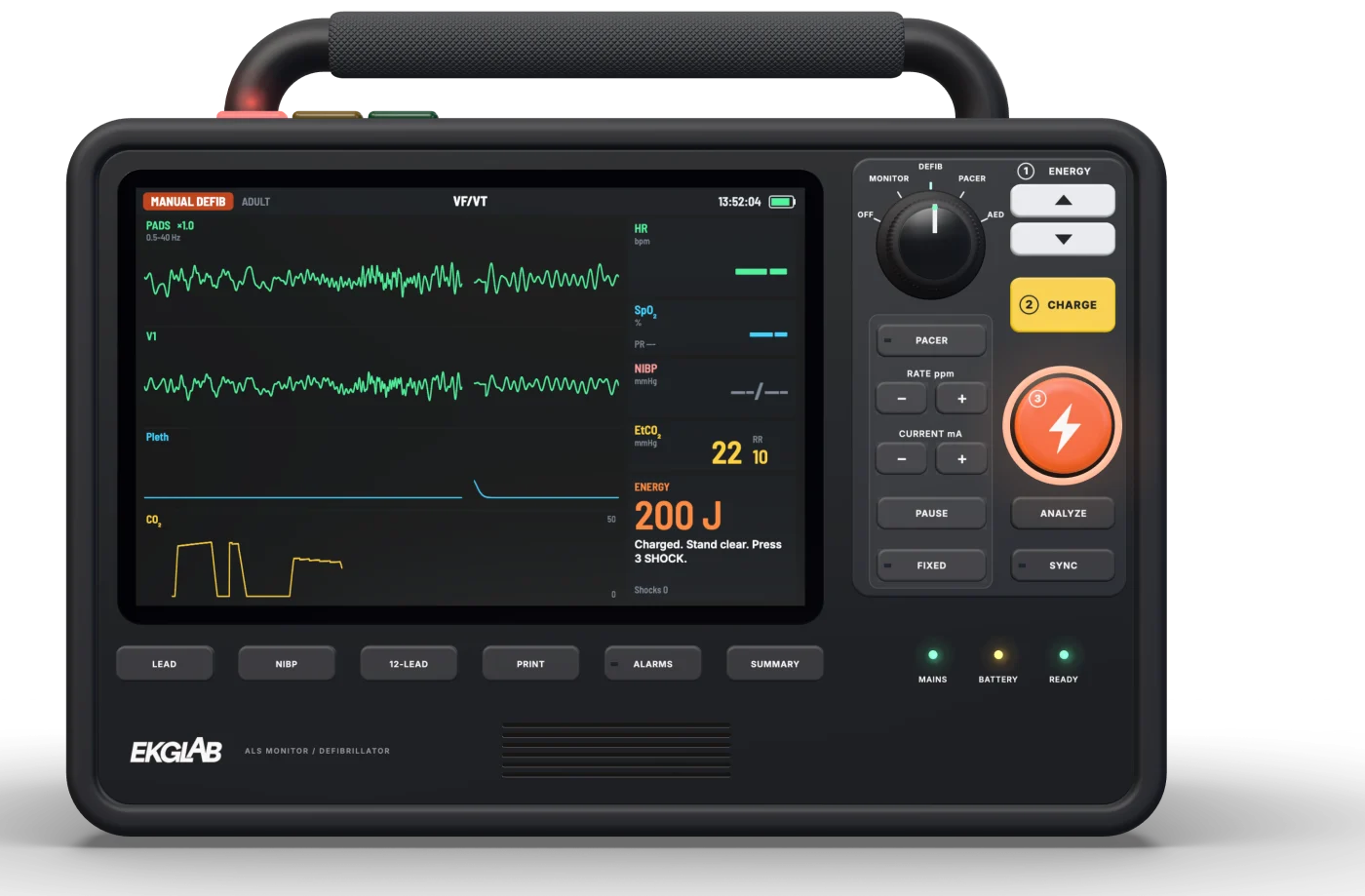
How megacode practice works
The case follows its script, every action is timed, and the debrief checks what was done against the algorithms of the AHA's 2025 guidelines.
-
Choose a case and who leads
8 megacodes follow the 2025 megacode testing sequences, and 11 shorter stations each take one part of the algorithms.
Lead it yourself as a Self-test, or run it for a team as the instructor. Practice gives the next step and its reason after each action; Test gives nothing until the debrief.
Lightheaded and pale11 minBradycardiaPulseless VTPEAPost-arrest careShort of breath at home15 minBradycardiaVFAsystolePost-arrest careChest pain in the emergency department12 minUnstable tachyVFPEAPost-arrest care -
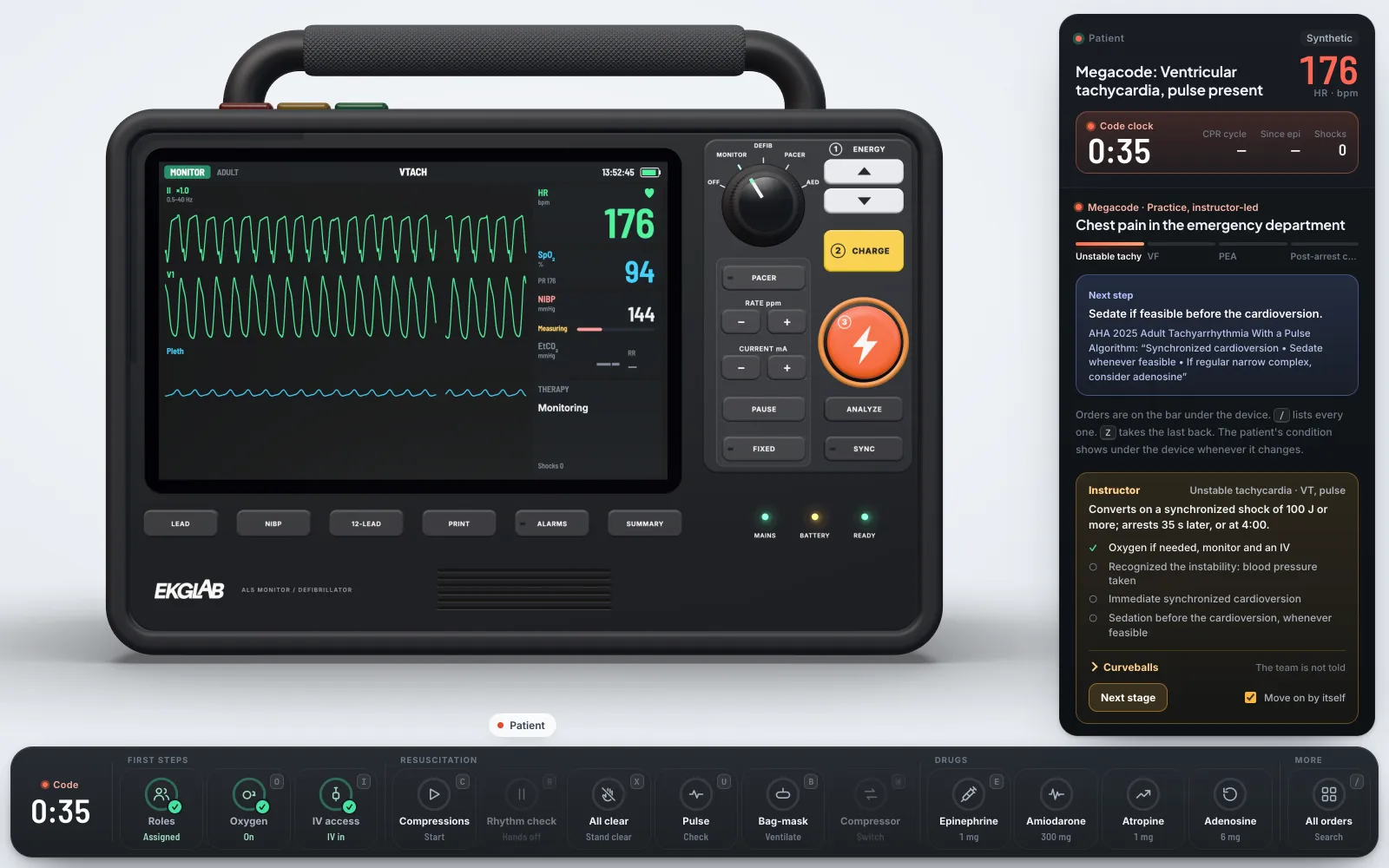
Run the code on the device
The rhythms change as the case moves on. The team's orders sit on a bar along the bottom: compressions, rhythm checks, oxygen, an IV, epinephrine, amiodarone and more, each with its own key.
The device is yours to work: turn the selector, set the energy, charge, shock, synchronize, pace. The code clock, the cycle timer and the time since epinephrine run above the console.
-
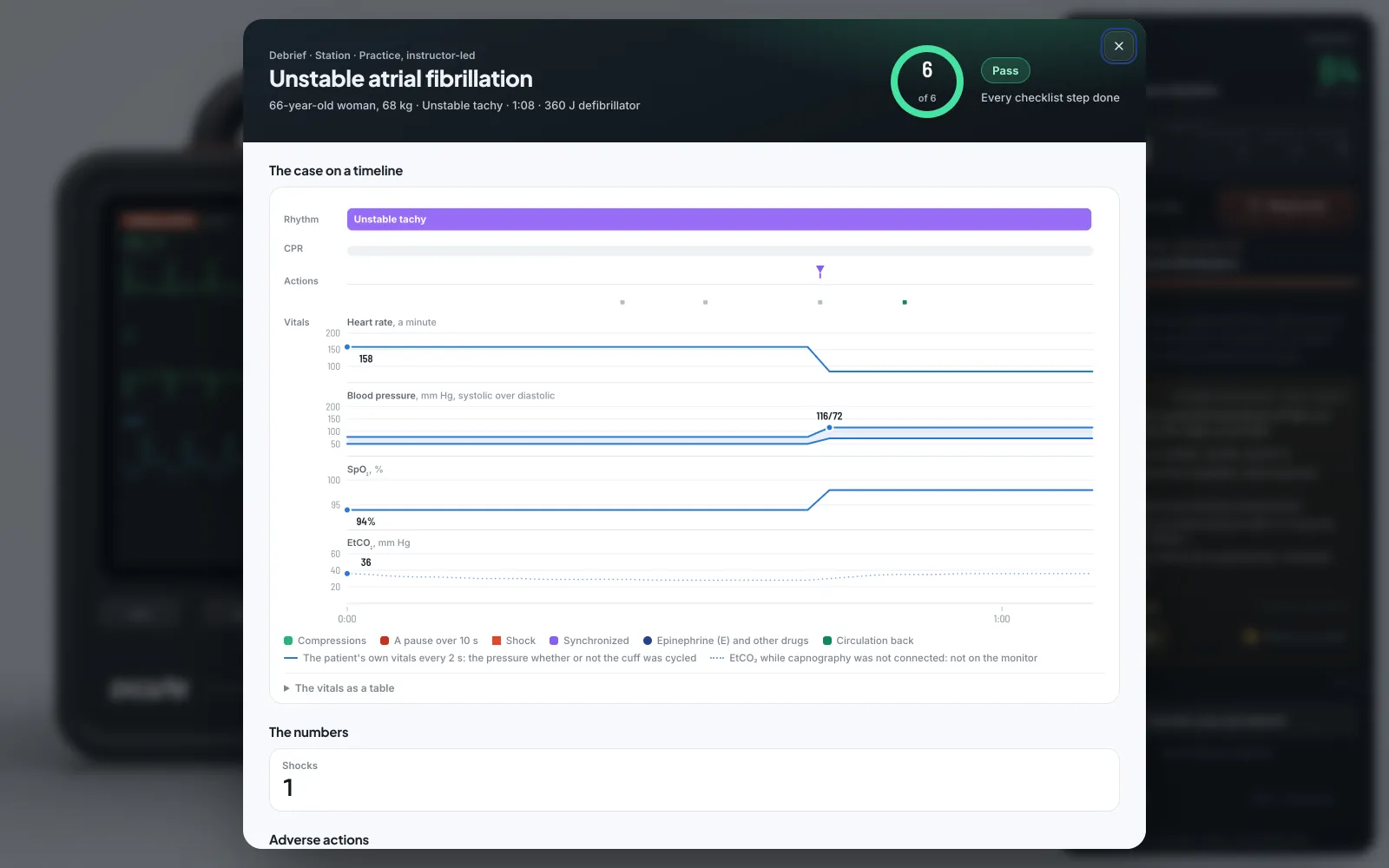
Read the debrief
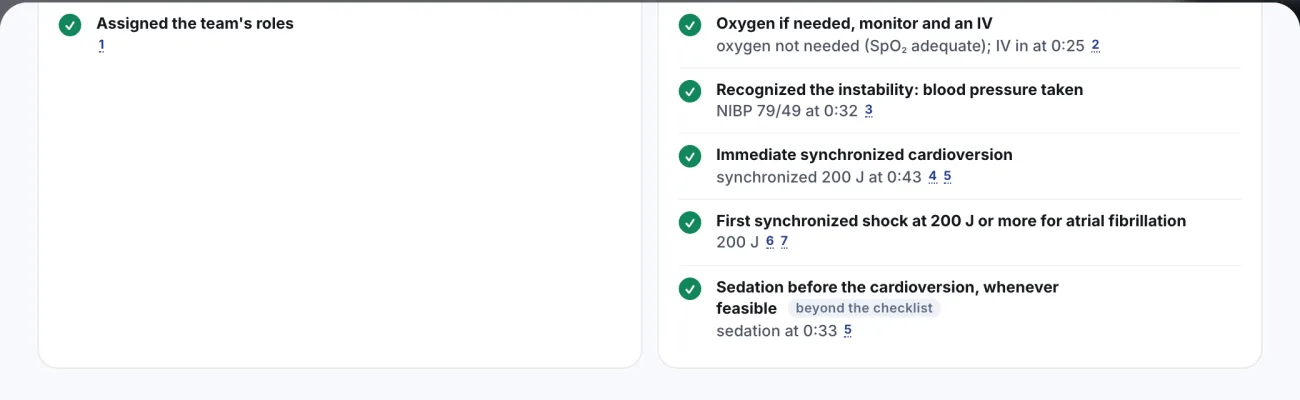
Each checklist step is marked met or not met, with the time it was done and the source it comes from. A timeline lays out the rhythms, the compressions, the shocks and the vitals.
The numbers include time to compressions, time to the first shock, time to epinephrine and the chest compression fraction. A case run to its end is Pass or Needs remediation, the two results of the megacode testing checklist.
An ACLS simulator with a defibrillator that works
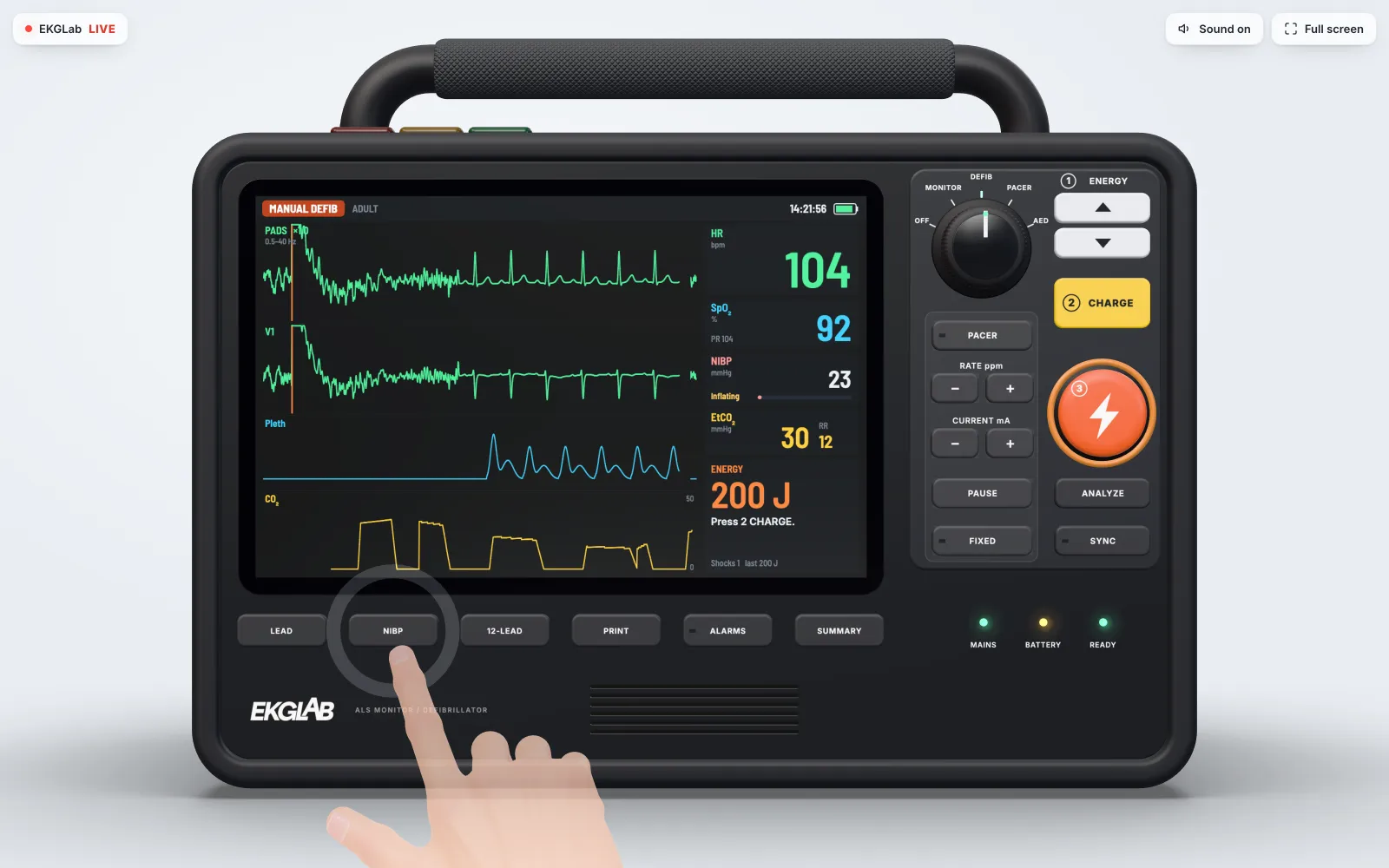
Every key on the device does what it says. It is modelled in 3D and drawn live, so the screen, the lights and the printer respond as you work.
- 12 CHARGE3 SHOCK
- Manual defibrillationSet the energy, charge, and shock when the ring flashes. The charge time grows with the energy.
- SYNC
- Synchronized cardioversionSYNC marks each R wave and the shock waits for the next one.
- PACERRATECURRENT
- Transcutaneous pacingRate 30 to 180 ppm and current 0 to 200 mA, on demand or fixed, with capture once the current reaches the threshold.
- ANALYZE
- AEDAnalyze, then shock advised or no shock advised, with the device charging itself.
- C
- CPR with feedbackThe CPR sensor's bars take V1's place, the compressions show on the ECG, and the device works out the compression fraction.
- NIBPLEAD
- MonitoringLead II and V1, the pleth wave and the capnogram, with the heart rate, SpO2, blood pressure, EtCO2 and breathing rate.
- 12-LEAD
- A 12-lead on screenA 10-second acquisition, then the 12 leads with the measurements: heart rate, PR, QRS, QT and QTc, and axis. No interpretation.
- PRINTSUMMARY
- Printer and code summaryPrint the strip, the 12-lead or the event summary, and see every event of the code with its time.
Every tracing is synthetic, drawn live by EKGLab's Waveform Studio engine. It is a teaching simulator, not a medical device.
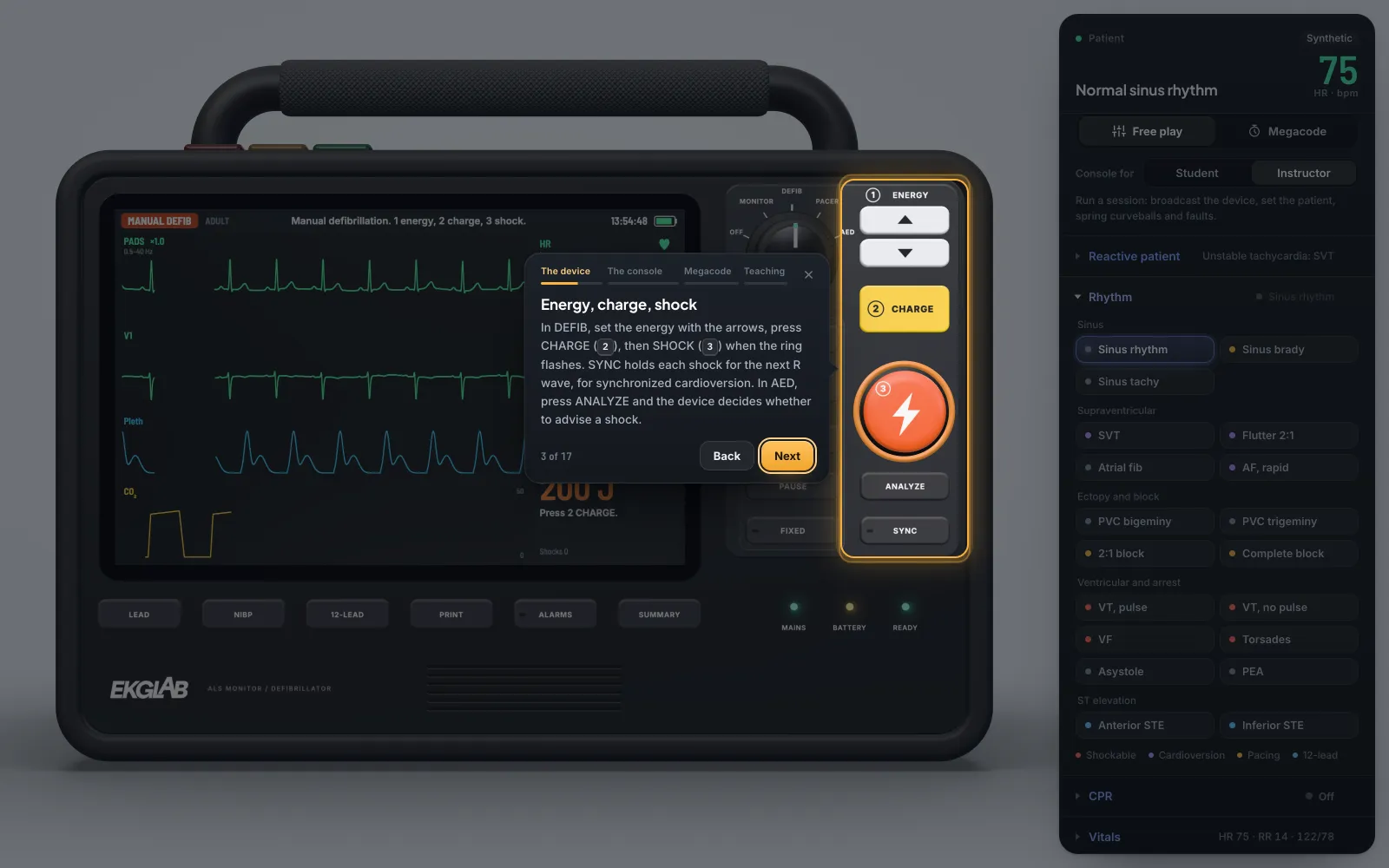
Free play: any rhythm, any setting
Practice the device without a script, at your own pace. Free play is on every plan, the free one included.
19 rhythms: the ACLS rhythms and more
The ACLS rhythms, from bradycardia and the AV blocks to the tachycardias, VF, pulseless VT, torsades, PEA and asystole, with PVCs and ST elevation too. Pick the patient's rhythm, then set the heart rate, breathing rate and blood pressure, and add PACs or PVCs.
Sinus- Normal sinus rhythm
- Sinus bradycardia
- Sinus tachycardia
- Supraventricular tachycardia (SVT)
- Atrial flutter, 2:1 conduction
- Atrial fibrillation
- Atrial fibrillation, rapid ventricular response
- Sinus rhythm with PVCs in bigeminy
- Sinus rhythm with PVCs in trigeminy
- Second-degree AV block, 2:1 conduction
- Complete heart block
- Ventricular tachycardia, pulse present
- Ventricular tachycardia, no pulse
- Ventricular fibrillation
- Torsades de pointes
- Asystole
- Pulseless electrical activity: sinus rhythm, no pulse
- Anterior ST elevation
- Inferior ST elevation
6 guided skills
Drills that tick off each step as you do it on the device.
- Defibrillate VF
- Cardiovert VT with a pulse
- Pace a complete heart block
- CPR and a shock
- Take a 12-lead ECG
- Troubleshoot
A reactive patient
15 starting patients with no script: each responds to whatever is done, right or wrong, and says why. Nothing is scored.
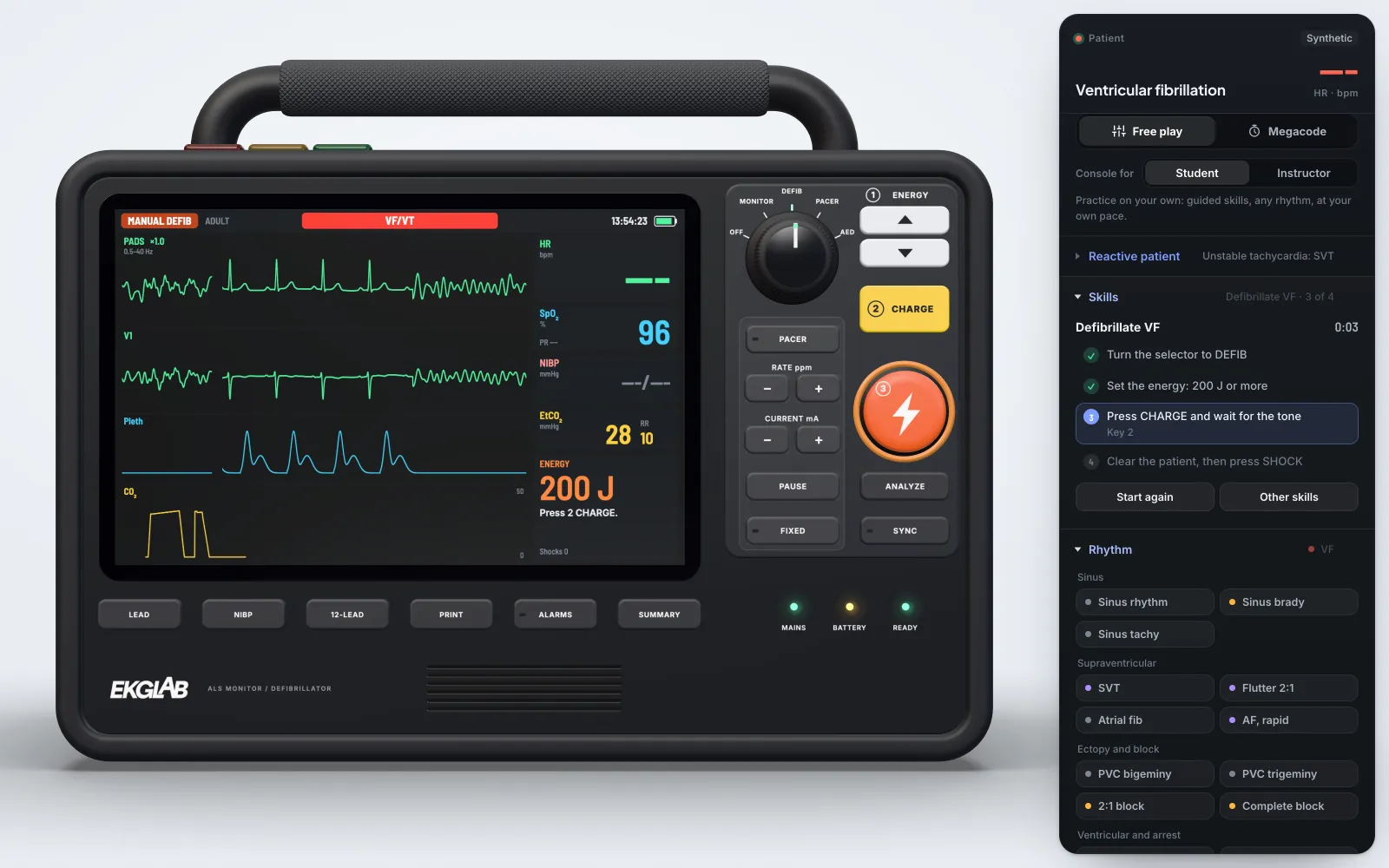
Megacode simulations for a class
On the Instructor plan, run a mock code for a team and put the device on the projector.
- Instructor-led casesA mock code with the script, the patient's story and the checklist as it fills, and the case's next stage when you choose.
- Curveballs and faultsPads off, an ECG lead off, a low battery, loss of capture, a tiring compressor, a dislodged tube: spring one, and switch it off once the team puts it right.
- A student screenThe device alone, in a second tab of the same browser, to drag to the projector. Students see the screen and a hand on each key you press, and nothing of your console.
- A session logEverything done on the device, and each curveball, with its time.
The megacode scenarios
Seven of the eight megacodes follow one of the AHA's six megacode testing sequences. One (bradycardia, pulseless VT, asystole) is EKGLab's own sequence; each of its stages follows the algorithm for that rhythm.
Megacodes
Stations
Megacode practice on every plan
Start with free play. Every megacode case comes with Pro or the 3-Month Pro Pass, and teaching a class with Instructor.
Pro
$29/year
billed annually, cancel anytime
Start ProEverything in Free, plus
- All 19 megacode cases, as a Self-test
- Practice or Test, the next step and its reason, or nothing until the debrief
- The scored debrief, each step met or not met, with its time
- Every other Pro feature, from quizzes and True Sim to ARIA
3-Month Pro Pass
No subscription$9.99/3 months
one payment, never renews
Get the 3-month passEverything in Pro, for 3 months
- Every megacode case, with the debrief, as in Pro
- Starts the day you buy it
- One payment, never charged again
- Back to Free when it ends, with your progress kept
Using EKGLab all year? Pro at $29 a year costs less.
Instructor
10 seats$99/year
10 student seats included
Get InstructorEverything in Pro, plus
- Instructor-led megacodes, with the script and the checklist
- Curveballs and faults, with the session log
- The student screen, for a projector
- 10 student seats, add more any time
Free
$0
free forever, no card required
Free play on the Megacode Simulator.
- Free play, every rhythm and setting
- The 6 guided skills, step by step on the device
- The reactive patient, 15 starting patients
- The guided tour of the device
Plus tax where it applies. Pro and Instructor renew each year and can be cancelled any time; the 3-Month Pro Pass never renews. Everything each plan includes
Megacode simulator questions
What is a megacode simulator?
A megacode is the scenario test of an ACLS course: a team leader runs a simulated patient through a sequence of rhythms while the team works, and each step is checked against a testing checklist. This megacode simulator runs those cases on a working 3D monitor-defibrillator in your browser: the rhythms change, the device responds to every key, and the debrief shows what was done and when.
Can I practice a megacode online for free?
Yes. The demo on this page needs no account: free play is open, and so is one megacode, Chest pain in the emergency department, Instructor-led or as a Self-test. A free EKGLab account keeps free play; every megacode case is included in Pro.
Which megacode scenarios are included?
8 megacodes and 11 stations. Seven of the eight megacodes follow one of the AHA's six megacode testing sequences. One (bradycardia, pulseless VT, asystole) is EKGLab's own sequence; each of its stages follows the algorithm for that rhythm. The stations each take one part of the algorithms, from VF and pulseless VT to post-cardiac arrest care.
Is the simulator approved or endorsed by the American Heart Association?
No. It is EKGLab's own software verification: tests written from the AHA's published text and run against the simulator. It is not a review, approval or endorsement by the American Heart Association. EKGLab is not affiliated with the AHA.
Are the rhythms real patient ECG recordings?
No. Every tracing in the simulator is synthetic, drawn live by EKGLab's Waveform Studio engine for teaching. Its 12-lead shows the measurements only, with no interpretation.
Can an instructor run megacode simulations for a class?
Yes, on the Instructor plan: run a case Instructor-led with the script and the checklist in front of you, spring curveballs such as pads off or a tiring compressor, and open the student screen in a second tab for the projector. Students see the device and a hand on each key you press.
What do I need to run it?
A laptop or desktop computer and a current browser, Chrome, Edge, Safari or Firefox. The device and its console need the width of a laptop screen, so a phone is too small.
Is this clinical advice?
No. The Megacode Simulator is a teaching simulator, not a medical device, and the patient's response to a shock or to pacing is the simulation's choice. Follow your own course, your instructor and your institution's protocols.